Challenge · Part-145
Too few mechanics, too slow to qualify
The technician shortage isn't coming — it's here, for years. The organisations that cope are the ones whose people become productive fastest and stay productive longest.
[photo] A busy but orderly hangar floor
A busy but orderly hangar floor: two mechanics at an open engine cowling, a third walking past with a tablet — motion, competence, no idle staging. Wide shot, daylight through hangar doors. European MRO, workwear, no liveries.
BildvorschlagThe situation

Boeing's technician outlook puts the global need at hundreds of thousands of maintenance technicians over the coming decades. Whatever the precise number, every MRO feels the local version: hiring is slow, and every mechanic you have is needed on aircraft — not in classrooms.
That creates a genuine dilemma. Broadly cut authorizations demand long training paths: months in which a new hire is neither fully trained nor productive. But narrowing what people may do feels risky when records are managed by hand — so organisations default to long, broad, slow.
And the recurring load compounds it: continuation training alone consumes one to two full days per mechanic per year — usually as whole days off the floor.
Why it keeps happening
Broad authorizations, long runways
The wider the authorization, the longer until anyone holds it — and until they produce.
Small scopes need fine control
Task-sharp authorizations are only safe when the system tracks exactly who may do what. Spreadsheets can't.
Training eats whole days by default
Without the tooling to split and spread it, recurrent content is delivered in day-blocks.
How cimoio.aero solves it
-
Cut authorizations small and sharp
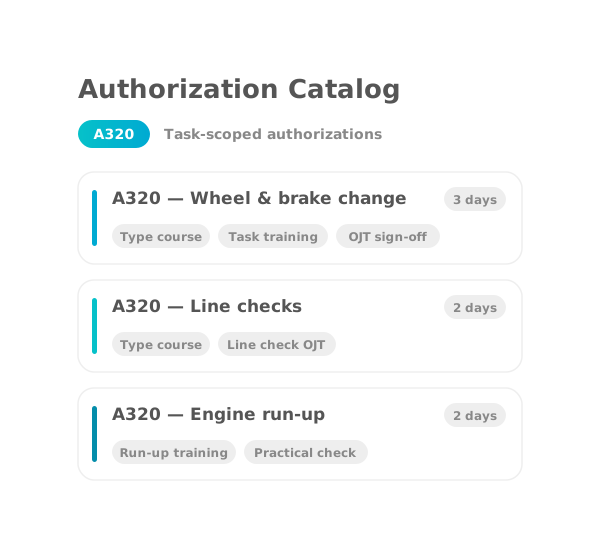
Define authorizations along the work actually performed. Short training path, early productivity: a mechanic cleared for a specific scope works today — and extends scope by scope.
-
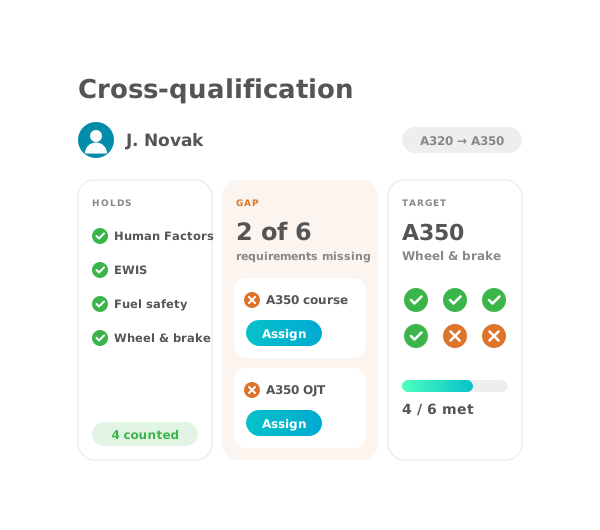
Cross-qualify along the gap, not from zero
Moving a mechanic to another type or scope starts with the gap list: what they already hold counts, what's missing is precisely named and bookable. Small scopes mean small gaps — and fast transitions.
-
Spread recurring training through the year
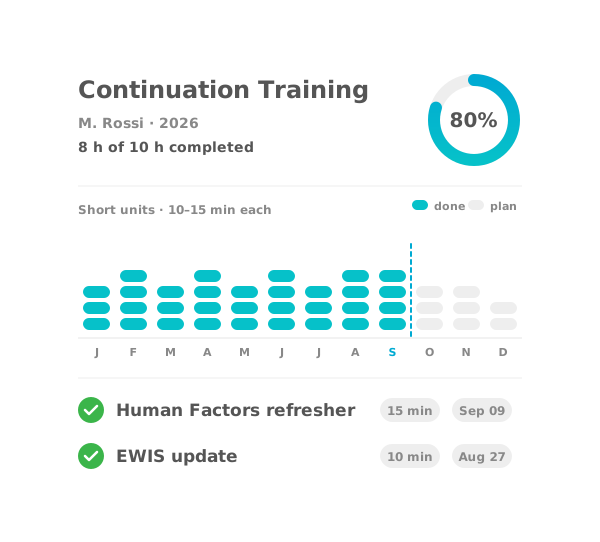
Where regulation permits, continuation training is delivered in short online units through the year — fifteen minutes after lunch instead of two full days off the aircraft. Completion and evidence track automatically.
The functions behind it
Make the workforce you have go further
In a guided demo we model one of your real cross-qualification cases — and show the gap, the path and the timeline.
Or start faster with Compliance as a ServiceMore challenges
-
Qualification data spread across too many systems
Ask organisations where their problems come from and the answer repeats: the process runs across four tools that don't talk to each other — and people carry the data in between.
-
Coordination overload with training providers
Every external course means the same loop: send the participants, chase the confirmations, handle the changes, collect the certificates. Multiply by every course, all year.
-
Proving compliance takes days
The question is always simple: who is authorized, since when, and on what basis? It's the answering that takes days — unless the answer is one click away.