Challenge · Part-145
Authorizations expire — or exist when they shouldn't
In a Part-145 organisation, only authorized staff may perform and release work. Every authorization that lapses unnoticed — or was granted without full backing — puts you in violation of aviation law.
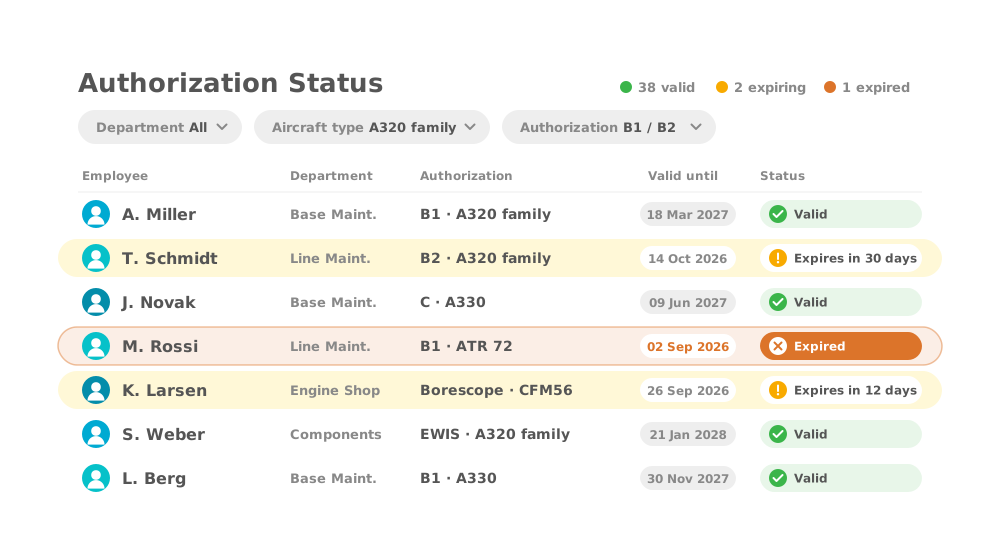
The situation

An auditor walks your hangar, picks a mechanic at random and asks a simple question: is this person authorized for the work they are doing right now — and can you prove it?
That is the moment every quality and compliance manager prepares for. Authorizations rest on qualifications: trainings, certificates, experience, a competence assessment. Each of them has a validity. When one of them expires and nobody notices, the authorization silently loses its foundation — but the certificate on the wall still says otherwise, and the mechanic keeps signing.
The duty runs in both directions. Staff must know what they are — and are not — authorized for. And when an authorization can no longer be backed, it must be revoked in time and the employee informed, before unauthorized work happens. All evidence has to be presentable within 24 hours.
Why it keeps happening
Validity lives in too many places
Trainings in one list, authorizations in another, certificates in a third. No digital link between them means no automatic warning when the chain breaks.
Manual transfer, manual errors
Every expiry date copied by hand between systems is an opportunity for a wrong digit — and a wrongly valid authorization.
The two-year workaround
Many organisations let all authorizations expire on a fixed cycle and re-issue them in bulk, because continuous monitoring wasn't feasible. Between cycles, nobody really knows.
The person who knew is leaving
For decades, one experienced colleague kept the overview in their head. That knowledge retires with them.
How cimoio.aero solves it
-
Every authorization knows its foundation
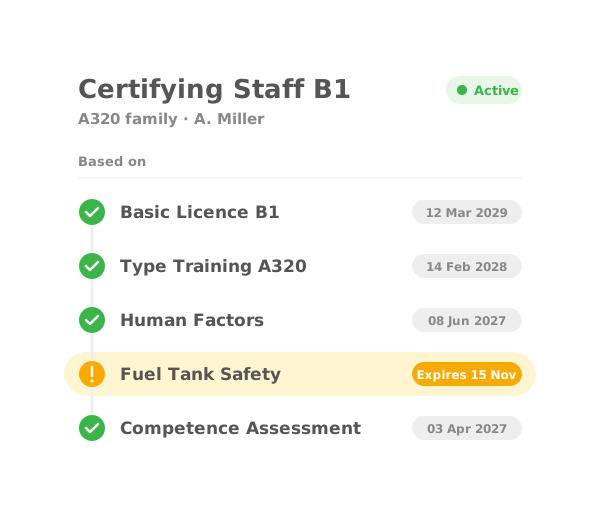
In cimoio.aero, an authorization is not a document — it is a living link to the qualifications it rests on. The system knows which trainings, certificates and assessments back each authorization, and how long each of them is valid.
-
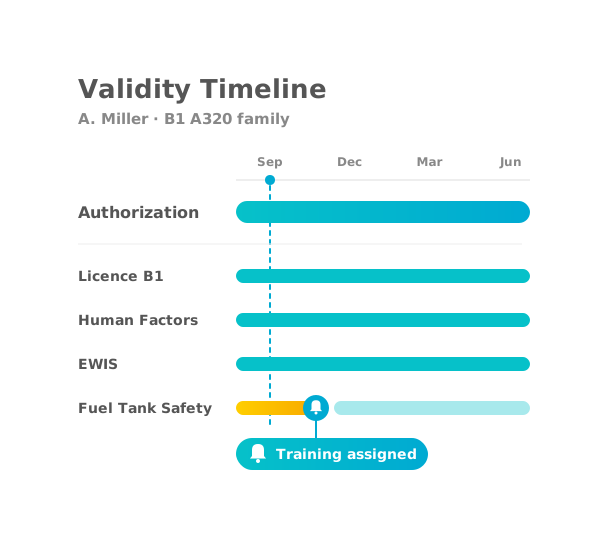
Renewal runs rolling — not in two-year waves
When the next qualification approaches expiry, the system flags it and triggers the training need — employee and responsible managers are notified automatically. Once the training is done and the certificate is in, the authorization simply continues. No cliff-edge dates, no bulk re-issuing, no surprises.
-
If it can't be backed, it's revoked — everywhere
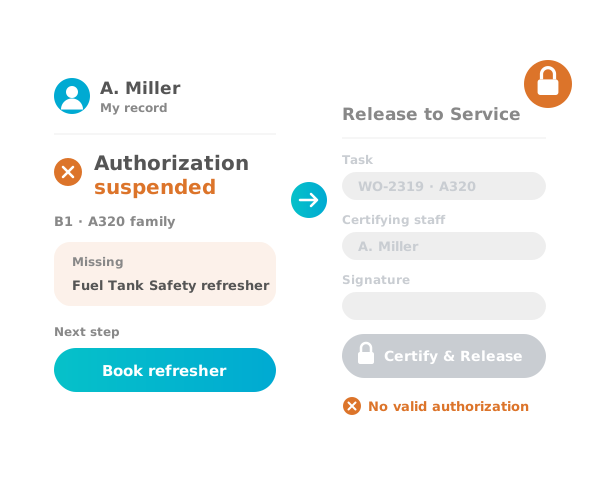
If a qualification does lapse, the authorization is digitally revoked, the employee sees it immediately in their record — and the information travels on: connected ERP and MRO systems can block release steps, so signing without a valid authorization becomes technically impossible.
The functions behind it
Authorization Management
Define, grant, monitor and revoke authorizations with full traceability.
Learn moreQualification Management
Model every path to a qualification and keep validities under control.
Learn moreCertificates & Record Keeping
Every authorization backed by the right certificate, retrievable in seconds.
Learn moreCompliance as a Service
The fastest way out: Compliance as a Service
Pre-configured software, best-practice processes and qualification content — ready to operate in 4 weeks.
[photo] A calm, confident scene
A calm, confident scene: a quality manager (40s–50s, polo shirt, no suit) at a standing desk at the edge of a hangar, tablet in hand, aircraft out of focus in the background, daylight. Mood: everything under control — not celebratory, not stock-polished. European MRO setting, no visible airline livery or logos.
BildvorschlagMore challenges
-
An audit finding forces you to act now
-
Your qualification experts are retiring
The colleague who knows which training leads to which authorization — and which provider can deliver it by next month — is leaving. The knowledge was never written down.
-
Training costs keep rising
Recurrent trainings multiply, budgets don't. And when nobody can tell exactly who needs which course, the safe answer is expensive: send everyone to everything.